A defrosted conflict
2024-07-11 16:07
For most countries in Eurasia, the period between 1950 and the end of the first World War is some sort of foundational cycle, surrounded by mystery and propaganda. Everyone’s home land was born more or less around those years, and every single leader struggled, sometimes successfully, to explain to locals and foreigners that actually, their identity and history has much, much older roots.
In some cases this required a lot of blood but little controversy, e.g. the final post-WW2 border settlement between Yugoslavia and Italy, which caused so-called “historical Italian lands” to cease to be Italian for good, and nowadays the success of that plan is shown by the absence of irredentism on the Italian side. And, after all, on all sides, since nobody questions the status of Trieste anymore. In other cases it required a lot of blood and wounds that are still open, such as the 1924 Greco-Turkish population exchange, as the Turkish ruling class still talks about “throwing Greeks to the sea”1. On the other side, Greeks still say Κωνσταντινούπολη (yes, Constantinople).
Transcaucasia?
The Caucasus, and Transcaucasia in particular, is an example on the fact that “if you don’t call for nationhood for yourself, nobody else will”. And of course, no matter how much blood is spilled, there can always be more.
The main difference between South (Transcaucasia) and North Caucasus is precisely the former. In that aforementioned period, 1850 to the 1910s (1918 to be precise), one after the other, the three republics-to-be laid claims to parts of the territory they now occupy. The northern subjects didn’t do so, and this is why there is a Republic of Azerbaijan while there isn’t a Circassian Republic. Chechnyans tried much later than it was socially accepted to use violence to this end, and the result wasn’t what they had desired.
On spilling blood, the Caucasus has been the theatre of the first modern genocide, which served as a blueprint for both the Armenian Genocide and the Holocaust. It was also the most successful in its intent, since while there is a Republic of Armenia, however shrunk, the Circassians don’t have their own state, and in line with the good old Russian divide et impera of its subjects, they’re spread between two federal entities with two names, languages, identities2.
It’s very hard to trace an unbiased history of the three Transcaucasian nations, but there are a few things that are factual.
Armenians
Armenians lived pretty much everywhere. They had strong presence in cities, extending way beyond the Caucasus. Pre-genocide, besides the six Ottoman vilayets (Sivas, Diyarbakir, Van, Maamuret el-Aziz, Erzurum, Bitlis), there was a strong Armenian presence in Constantinople and more southern cities like Beirut or Aleppo.
They were more or less the first to gain enough self-determination to desire their own State, but the fact that they were never a majoritarian ethnic group anywhere major (perhaps except the city of Van), including the current capital of Yerevan, was one of the main reasons for the disaster that followed.
Georgians
Georgians were luckier in that besides a few communities scattered within the borders of Persia, they were a majority in a lot of their current territory. Also, there wasn’t a lot of controversy on its northern and south-eastern borders (except the status of Batumi, which turned into Georgia’s favour). This was a good starting point, something that the newborn Armenia didn’t have.
True, the status of the capital, just like Yerevan’s and Baku’s, was not to be taken for granted as all of them were very multicultural until the 20s, but the events that followed took a decision for everyone.
Azerbaijanis
The status of Azerbaijan was mixed. Nowadays it’s easy to fall for propaganda stunts claiming that Coca-Cola is older than Azerbaijan – true, but similar reasoning also applies to places like Latvia or Slovenia – but what one should not forget is that “the muslims of Southern Caucasus” were a real group, for a while. Unlike Georgians and Armenians, they were not a sort of “one nation - one language group”. The multiethnic community, was never fully Azeri, Turk, Tatar, or whatever one called them over the decades, only became so in the past 30 years, much as the regime currently in power likes to claim otherwise3.
We can agree that the Azerbaijani nation-building process only followed4 and mirrored the two neighbours’, but this point, or the fact that “the muslims of Southern Caucasus” have had a shorter presence in the land than Armenians and Georgians is unfair and it’s a claim that has never been applied to other nations.
Nevertheless, what was not reality in 1918 became so in 2023 when Azerbaijan became a fully Azerbaijani nation.
Nation building in the Soviet era
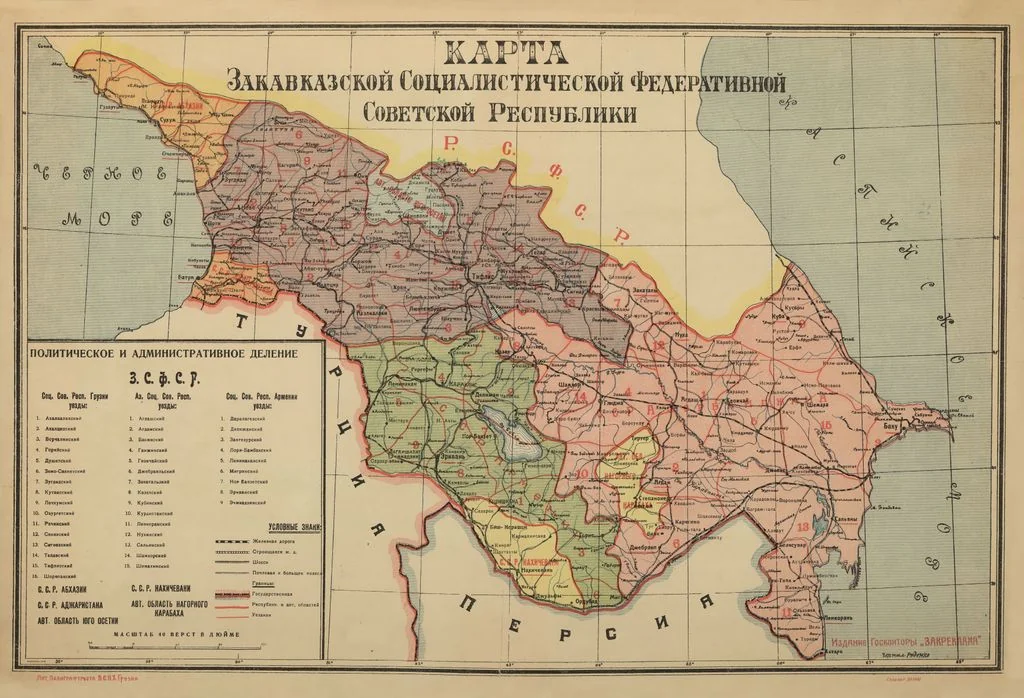
The events leading to the formation of the three republics were very diverse. While it might have seemed that Georgia was the luckier one of the three, it included three special regions within its territory: Abkhazia, South Ossetia and Adjara, the region of the aforementioned Batumi. As mentioned before, the Adjara matter got sorted out relatively easily, maybe because of the lack of a border with Russia proper, but the other two dragged on into two full-scale conflicts.
One can argue that those three regions weren’t even “part of the territory of Georgia”, and in times of peace, whether they did or not, it didn’t really matter much5. It is also true that the ethnicities that claim the namesake of the two entities, the Abkhaz and the Ossetians, were not the majority of the population in those territories - they still aren’t, post-separation. But then again, neither were the Armenians in their own capital, by the time of the first Republic of Armenia.
Either way, while the case of Georgia sounded like a potential for an internal issue, Armenia and Azerbaijan weren’t as lucky. Soviet Armenia didn’t have special entities within its own territories, while Azerbaijan had two: Nakhichevan and Nagorno-Karabakh. Incidentally, both of them had a consistent Armenian presence, especially Nagorno-Karabakh.
The conflicts
Some often see the Soviet Union as a relatively harmonious time, with a large amount of nostalgia. This was somehow true for minority groups within the SSRs, as of course Soviet authorities had no issues with minorities within the SSRs when they danced to the central government’s tune – weakening SSR nationalism.
But even for those, it was often far from a large dinner party. After all, it was during the Soviet era that Nakhichevan got fully turkified, with all Armenian legacy wiped. At the same time, since the birth of the Nagorno-Karabakh Autonomous Oblast, tensions between the two communities were so frequent that it’s impossible to isolate the proverbial spark that ignited the conflict.
In a way, it’s bizarre to think that the progressive and complete ethnic cleansing of Nakhichevan is barely remembered while subsequent conflicts that had similar results got much more echo and coverage.
One man’s Khojaly, another man’s Sumgayit
In the case of the Nagorno-Karabakh conflict, one of the overarching issues is that one can find a lot of smoking guns, and each party can always find a better one if we want to go arbitrarily back in time.
The two symbolic massacres of the first Nagorno-Karabkh war, Sumgayit (1988), against the Armenian population, and Khojaly (1992), against the Azerbaijani population, have all sorts of accounts and narratives, from denialism, through minimisation, to justification.
In all of this the conflict has failed everyone involved. Even through the two decades of Armenian supremacy, Azerbaijani IDPs6 have been forgotten, left alone, and used by the subsequent Azerbaijani regime as part of their propaganda. The figures of Azerbaijanis kicked out of Nagorno-Karabakh – and the surrounding territories, which Armenians often forget they were not part of the original deal – are conflated with the ones of Azerbaijanis evicted from the territory of Armenia, mirroring a similar pogrom happening in Azerbaijan, against Armenians7.
At the end of the day it’s hard to justify or condemn one way or another to react to such catastrophes. Weaponising IDPs waiting for something to happen on a political level gives a terrible quality of life to the people involved but ultimately, in the case of Azerbaijan, it made for an effective boost for the popularity of the regime, or, at least, some of its policies – especially the one involving Armenia.
On the other hand, Armenia’s policy of being a safe home for “all the Armenians” regardless of recent residence, from Aleppo to Los Angeles might be politically unpopular for a territory that seems to shrink more year after year, but it does guarantee a reasonable quality of life to the Armenians that want to move there.
The defrosted conflict: Second Karabakh War and beyond
Political miracles don’t usually happen, and when they do, they usually don’t happen in dictatorships. Most that one can hope is neighbourly coexistence, and unless there will be another war in the future that turns the tide, Nagorno-Karabakh has been integrated within the Republic of Azerbaijan, granted no special status. Sacrifices aside, it’s just a new Nakhichevan, a mountainous area which according to Baku “is and has always been Azerbaijani”, and there isn’t much that any Armenian government can do to even guarantee the right of prospective returnees to Nagorno-Karabakh as citizens of Azerbaijan. At the end of the day, unless Armenia slips into an autocratic abyss, something that isn’t entirely unlikely to happen, from the people’s perspective, there is nothing to gain from moving back to a country with fewer freedoms than theirs, that teaches its citizens to hate Armenians8.
As an aside, one could think this way of reshaping borders is a special feature of the Caucasus. It’s not. It’s enough to look at Königsberg, Fiume, Triest, Danzig, and all those places that once were, and are no longer. At the end of the day few Austrians have been thinking of moving back to Trieste for the good old time’s sake – and likewise, Italians aren’t buzzing back to newly-in-Schengen Rijeka. If Trieste can have no Slavs or Hungarians and get away with it, so can Shusha or Khankendi.
As above, similarly to what happened in Nakhichevan, official Armenian policy towards Nagorno-Karabakh has been “recognition of the status quo”, i.e. the region being Azerbaijani territory, and a helping hand to the refugees to be integrated into the Republic of Armenia – with a lot of help from the local community.
Outside of the region this conflict has been read in a lot of different ways, from “yet another chapter of the genocide” to “justice towards Armenian aggression”, with special regards to “restoring the rule of law”. When it comes to Turkey, Azerbaijan’s greatest ally and provider of game-changing weapons in the Second Karabakh War, it doesn’t seem to apply to its own conflicts with Cyprus and Syria8. In Europe there has been a mixed bag of reactions, from a cynical non-interventionism “because of Azerbaijan’s role in gas supply” – ignoring the fact that Azerbaijan’s contribution is tiny, and EU member states’ confrontations with bigger suppliers such as Algeria are not unusual – to more religious undertones of “Christianity against Islam”.
The reality is that outside of your friend who played too much Europa Universalis and a few think tanks who like to write articles on the topic (some of them on Baku’s or the ANCA’s payroll), nobody actually cares about the Caucasus. Everyone who thought otherwise should look at Armenia’s northern neighbour, Georgia, who has a considerable experience on the topic.
- Interestingly these statements, mainstream in Turkish politics on both sides of the AKP/CHP barricade, are never taken into consideration by pro-turkish analysts who call foul about Turkey’s frozen EU membership application.
- Much as the status of Kabardino-Balkaria and Adyghea can be seen as an artificial division, it is true that, just like the diversity within the different Kurdish communities, the “one nation” view of “several tribes, one people” among the Circassians isn’t shared by everyone. Even from a linguistic perspective, Adyghe and Kabardian are often treated as two different languages, just like, e.g. Sorani and Kurmanji Kurdish.
- The nation-building process in Azerbaijan is a topic of its own merit that goes beyond current politics and revisionism by both the regime in power and the turkish establishment. The rhetoric of “two countries, one nation” is recent. It’s the outcome of a gradual process, but we must not forget that the push for Azerbaijani nationhood predates kemalism. All the founding fathers of 1918 Azerbaijan were more than conscious of what effect the roughly 100 years of Russian control had on their culture (positive effects too, compared to the “backwards” areas to the south), and it’s this melting pot that was the object of the “nationhood” debate. There were no plans of union with Turkey (which did not exist at the time) or irredentist claims towards the neighbouring region of Iran.
- This is where one can draw comparisons with “turkishness” within the Ottoman Empire. The reason why in this region muslim communities arrived late to the party is that in lands that were ruled by muslims for a long time such as the Caucasus or Anatolia, muslims were treated equally and subjected to the same laws, while non-muslims were granted a special status. As a result, muslims were “part of a big family” while the individual christian communities did not merge. This is what granted them earlier self-determination. The result of this process that bundled all muslim identities together within a single place is the root of many “tribal” issues, from the Kurds of Turkey to the galaxy of unrecognised communities of Iran.
- Officially, regardless, Abkhazia and South Ossetia were part of the Georgian SSR. This kind of “belonging” as an autonomous region within an SSR is the sort of fine line that is often used for Nagorno-Karabakh within SSR Azerbaijan, in that before the Alma-Ata agreements of 1991 “it was never really part of Azerbaijan”. This is one of the not-so-many parallels between the national conflicts in the Caucasus.
- Internally Displaced People.
- Much as the tragedy of being forced to leave Yerevan or Baku was not in the population’s wishlist at the time, there were several differences in status between the displacements. It wasn’t just that those who left “the capital” were generally richer and more educated – although Sumgayit wasn’t exactly the Silicon Valley –, refugees from Karabakh legally counted as IDPs and were always eligible to go back. Interestingly, Baku, having been banging on the IDP status’ drum for decades, is now conditioning the potential return of Armenians to Karabakh to the (also potential) return of Azerbaijanis to Armenia proper. Once again, two completely different cases.
- It’s not a coincidence that the regime in power in Azerbaijan is a gathering of Nakhichevanis, Yeraz (Yerevan Azerbaijanis) and Karabakh Azerbaijanis.